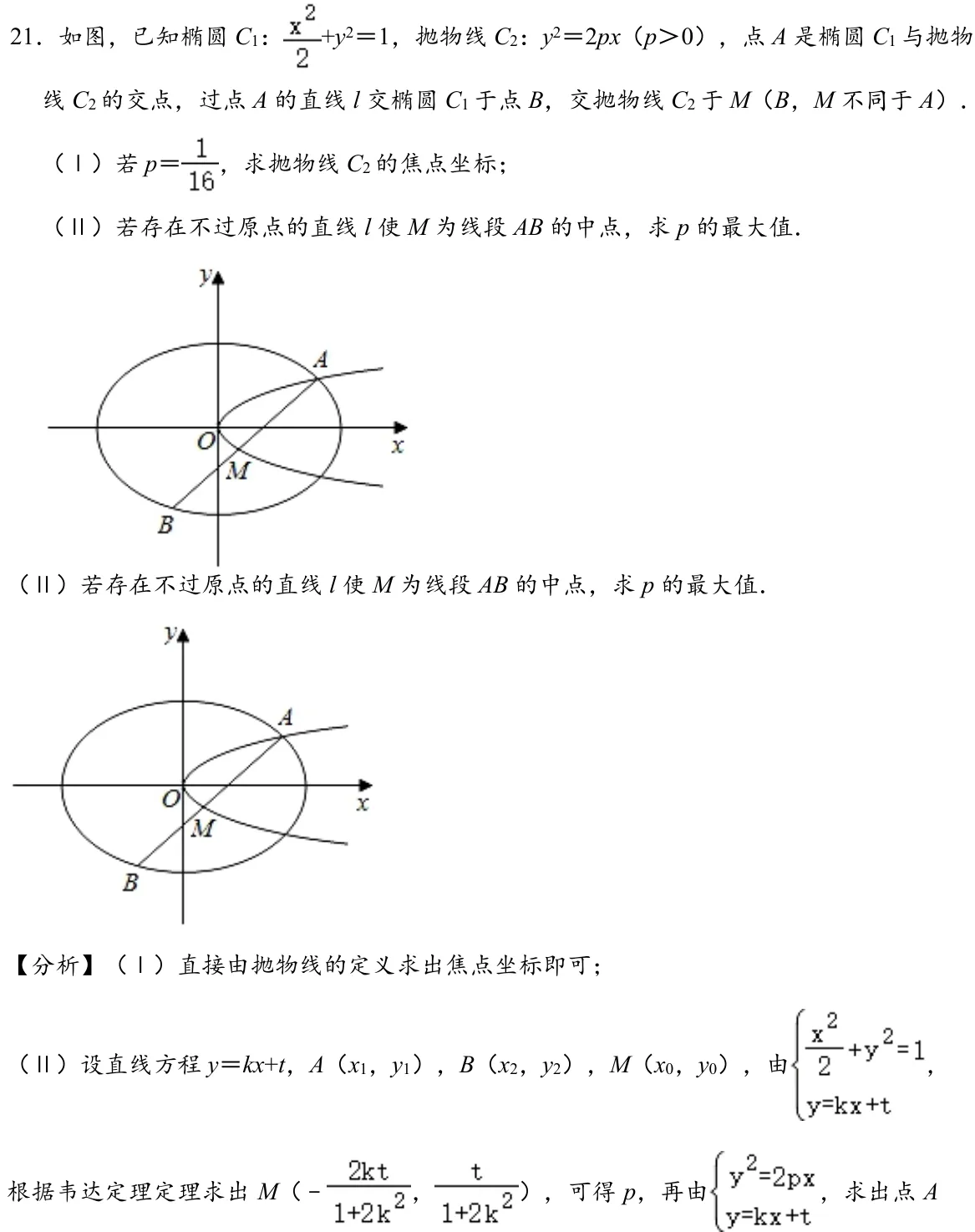
冷启动:图上有三个点,但只有两条曲线
先把题面翻译成「谁在哪条曲线上」——这道题的全部难度都在这张表里:
点 在椭圆 C 1 C_1 C 1 在抛物线 C 2 C_2 C 2 在直线 l l l A A A ✓ ✓ ✓ B B B ✓ ✓ M M M ✓ ✓
读出两件事,后面三条路都靠它们:
① A A A B B B l l l 椭圆 的两个交点;A A A M M M l l l 抛物线 的两个交点。
所以椭圆 那边可以用韦达(或点差),抛物线 那边同样可以——同一条直线,两套交点关系 。
② A A A p p p A A A 把 y A 2 = 2 p x A y_A^2=2px_A y A 2 = 2 p x A 椭圆 方程:
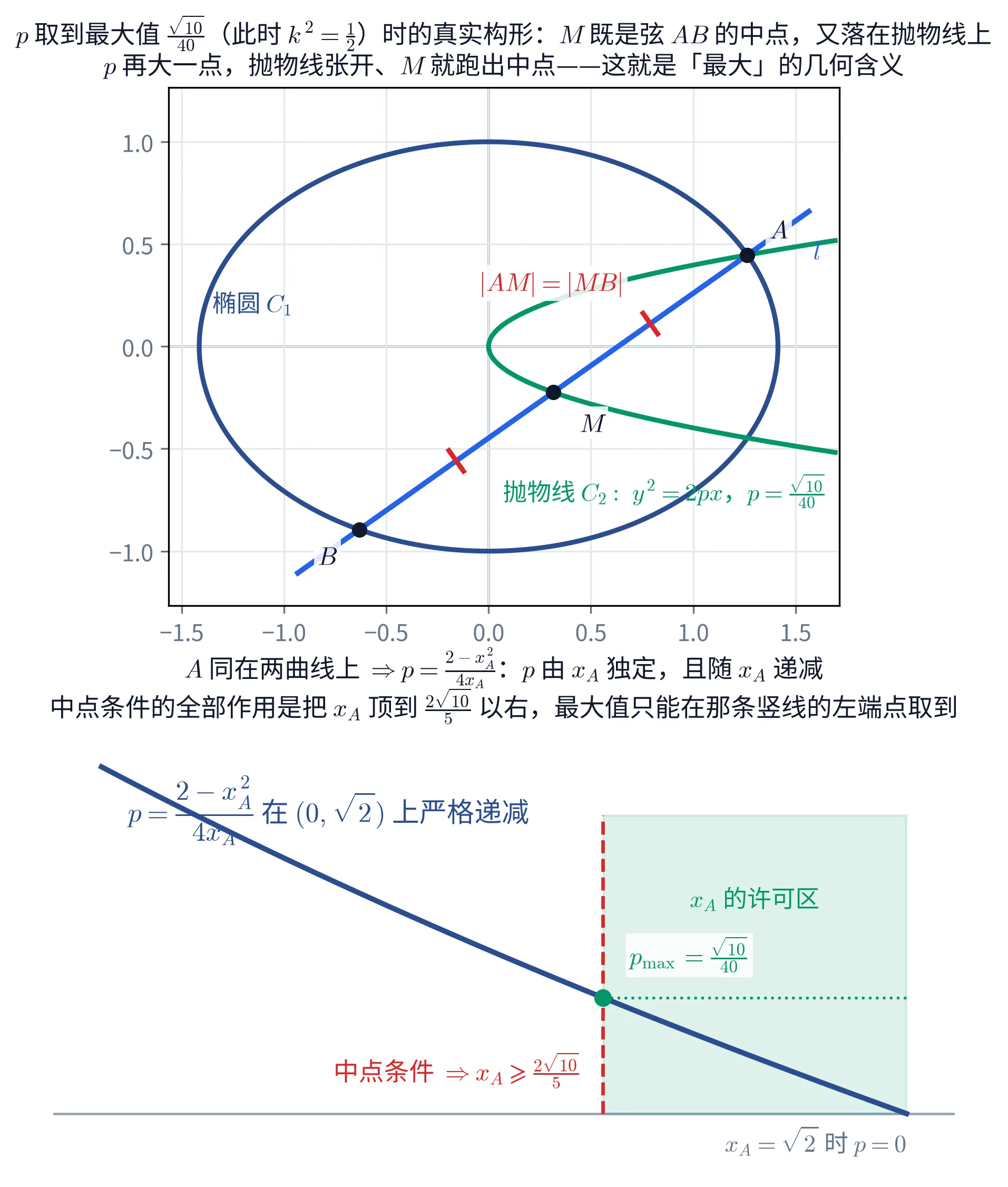
x A 2 2 + 2 p x A = 1 ⟹ p = 2 − x A 2 4 x A ( 0 < x A < 2 ) . \frac{x_A^2}{2}+2px_A=1\quad\Longrightarrow\quad p=\frac{2-x_A^2}{4x_A}\qquad(0<x_A<\sqrt2). 2 x A 2 + 2 p x A = 1 ⟹ p = 4 x A 2 − x A 2 ( 0 < x A < 2 ) . p p p x A x_A x A ( 0 , 2 ) (0,\sqrt2) ( 0 , 2 ) p = 1 2 x A − x A 4 p=\frac{1}{2x_A}-\frac{x_A}{4} p = 2 x A 1 − 4 x A p p p x A x_A x A 中点条件把 x A x_A x A
第三条路整条就是这句话;前两条路则是把同一件事换成 k k k
第(Ⅰ)问:一句定义的事
C 2 : y 2 = 2 p x C_2:\ y^2=2px C 2 : y 2 = 2 p x ( p 2 , 0 ) \left(\dfrac p2,0\right) ( 2 p , 0 ) p = 1 16 p=\dfrac1{16} p = 16 1
p 2 = 1 32 , 焦点 ( 1 32 , 0 ) . \frac p2=\frac{1}{32},\qquad \text{焦点}\ \left(\frac{1}{32},\ 0\right). 2 p = 32 1 , 焦点 ( 32 1 , 0 ) . 别把 p p p p 2 \frac p2 2 p :y 2 = 2 p x y^2=2px y 2 = 2 p x 准线 的距离才是 p p p
解法一:官方那条:设线联立,韦达定中点,再回抛物线 求 A
先排掉竖直的情形。 若 l ⊥ x l\perp x l ⊥ x 抛物线 只交于一点(抛物线 关于 x x x x x x M M M A A A l l l M M M A A A B B B
l : y = k x + t ( k ≠ 0 , t ≠ 0 ) . l:\ y=kx+t\qquad(k\neq0,\ t\neq0) . l : y = k x + t ( k = 0 , t = 0 ) . t ≠ 0 t\neq0 t = 0 k ≠ 0 k\neq0 k = 0 k = 0 k=0 k = 0 l l l 抛物线 只有一个交点,M M M
第一步:椭圆 那边用韦达求中点 M M M 把 y = k x + t y=kx+t y = k x + t x 2 2 + y 2 = 1 \dfrac{x^2}{2}+y^2=1 2 x 2 + y 2 = 1
( 1 + 2 k 2 ) x 2 + 4 k t x + 2 t 2 − 2 = 0 , (1+2k^2)x^2+4ktx+2t^2-2=0 , ( 1 + 2 k 2 ) x 2 + 4 k t x + 2 t 2 − 2 = 0 , 判别式 Δ = 16 k 2 t 2 − 4 ( 1 + 2 k 2 ) ( 2 t 2 − 2 ) > 0 \Delta=16k^2t^2-4(1+2k^2)(2t^2-2)>0 Δ = 16 k 2 t 2 − 4 ( 1 + 2 k 2 ) ( 2 t 2 − 2 ) > 0 t 2 < 1 + 2 k 2 t^2<1+2k^2 t 2 < 1 + 2 k 2
x A + x B = − 4 k t 1 + 2 k 2 ⟹ x M = x A + x B 2 = − 2 k t 1 + 2 k 2 , y M = k x M + t = t 1 + 2 k 2 . x_A+x_B=-\frac{4kt}{1+2k^2}
\ \Longrightarrow\
x_M=\frac{x_A+x_B}{2}=-\frac{2kt}{1+2k^2},\qquad
y_M=kx_M+t=\frac{t}{1+2k^2} . x A + x B = − 1 + 2 k 2 4 k t ⟹ x M = 2 x A + x B = − 1 + 2 k 2 2 k t , y M = k x M + t = 1 + 2 k 2 t . 第二步:M M M 抛物线 上,把 p p p 由 y M 2 = 2 p x M y_M^2=2px_M y M 2 = 2 p x M
p = y M 2 2 x M = t 2 ( 1 + 2 k 2 ) 2 2 ⋅ − 2 k t 1 + 2 k 2 = t − 4 k ( 1 + 2 k 2 ) . p=\frac{y_M^2}{2x_M}
=\frac{\dfrac{t^2}{(1+2k^2)^2}}{2\cdot\dfrac{-2kt}{1+2k^2}}
=\frac{t}{-4k(1+2k^2)} . p = 2 x M y M 2 = 2 ⋅ 1 + 2 k 2 − 2 k t ( 1 + 2 k 2 ) 2 t 2 = − 4 k ( 1 + 2 k 2 ) t . p > 0 p>0 p > 0 k t < 0 kt<0 k t < 0 k k k t t t
第三步:抛物线 那边再用一次韦达求 A A A A A A M M M l l l C 2 C_2 C 2 y = k x + t y=kx+t y = k x + t y 2 = 2 p x y^2=2px y 2 = 2 p x k 2 x 2 + ( 2 k t − 2 p ) x + t 2 = 0 k^2x^2+(2kt-2p)x+t^2=0 k 2 x 2 + ( 2 k t − 2 p ) x + t 2 = 0
x A x M = t 2 k 2 ⟹ x A = t 2 k 2 ⋅ 1 + 2 k 2 − 2 k t = t ( 1 + 2 k 2 ) − 2 k 3 , x_Ax_M=\frac{t^2}{k^2}
\ \Longrightarrow\
x_A=\frac{t^2}{k^2}\cdot\frac{1+2k^2}{-2kt}=\frac{t(1+2k^2)}{-2k^3}, x A x M = k 2 t 2 ⟹ x A = k 2 t 2 ⋅ − 2 k t 1 + 2 k 2 = − 2 k 3 t ( 1 + 2 k 2 ) , 再由 y A = k x A + t y_A=kx_A+t y A = k x A + t y A = t − 2 k 2 y_A=\dfrac{t}{-2k^2} y A = − 2 k 2 t
第四步:A A A 椭圆 上,把 t 2 t^2 t 2 代入 x A 2 2 + y A 2 = 1 \dfrac{x_A^2}{2}+y_A^2=1 2 x A 2 + y A 2 = 1
t 2 ( 1 + 2 k 2 ) 2 8 k 6 + t 2 4 k 4 = 1 ⟹ t 2 ⋅ ( 1 + 2 k 2 ) 2 + 2 k 2 8 k 6 = 1 ⟹ t 2 = 8 k 6 ( 1 + 2 k 2 ) 2 + 2 k 2 . \frac{t^2(1+2k^2)^2}{8k^6}+\frac{t^2}{4k^4}=1
\ \Longrightarrow\
t^2\cdot\frac{(1+2k^2)^2+2k^2}{8k^6}=1
\ \Longrightarrow\
t^2=\frac{8k^6}{(1+2k^2)^2+2k^2} . 8 k 6 t 2 ( 1 + 2 k 2 ) 2 + 4 k 4 t 2 = 1 ⟹ t 2 ⋅ 8 k 6 ( 1 + 2 k 2 ) 2 + 2 k 2 = 1 ⟹ t 2 = ( 1 + 2 k 2 ) 2 + 2 k 2 8 k 6 . 第五步:p p p k k k 由第二步 p 2 = t 2 16 k 2 ( 1 + 2 k 2 ) 2 p^2=\dfrac{t^2}{16k^2(1+2k^2)^2} p 2 = 16 k 2 ( 1 + 2 k 2 ) 2 t 2
p 2 = 8 k 6 16 k 2 ( 1 + 2 k 2 ) 2 [ ( 1 + 2 k 2 ) 2 + 2 k 2 ] = k 4 2 ( 1 + 2 k 2 ) 2 [ ( 1 + 2 k 2 ) 2 + 2 k 2 ] . p^2=\frac{8k^6}{16k^2(1+2k^2)^2\left[(1+2k^2)^2+2k^2\right]}
=\frac{k^4}{2(1+2k^2)^2\left[(1+2k^2)^2+2k^2\right]} . p 2 = 16 k 2 ( 1 + 2 k 2 ) 2 [ ( 1 + 2 k 2 ) 2 + 2 k 2 ] 8 k 6 = 2 ( 1 + 2 k 2 ) 2 [ ( 1 + 2 k 2 ) 2 + 2 k 2 ] k 4 . 分母上两处都往下放:1 + 2 k 2 ⩾ 2 2 ∣ k ∣ 1+2k^2\geqslant2\sqrt2\,|k| 1 + 2 k 2 ⩾ 2 2 ∣ k ∣ ( 1 + 2 k 2 ) 2 ⩾ 8 k 2 (1+2k^2)^2\geqslant8k^2 ( 1 + 2 k 2 ) 2 ⩾ 8 k 2
p 2 ⩽ k 4 2 ⋅ 8 k 2 ⋅ [ 8 k 2 + 2 k 2 ] = k 4 160 k 4 = 1 160 , p ⩽ 1 4 10 = 10 40 . p^2\leqslant\frac{k^4}{2\cdot8k^2\cdot\left[8k^2+2k^2\right]}=\frac{k^4}{160k^4}=\frac{1}{160},
\qquad p\leqslant\frac{1}{4\sqrt{10}}=\frac{\sqrt{10}}{40} . p 2 ⩽ 2 ⋅ 8 k 2 ⋅ [ 8 k 2 + 2 k 2 ] k 4 = 160 k 4 k 4 = 160 1 , p ⩽ 4 10 1 = 40 10 . 第六步:验等号真的取得到。 两处放缩同时取等都要 1 = 2 k 2 1=2k^2 1 = 2 k 2 k 2 = 1 2 k^2=\dfrac12 k 2 = 2 1 t 2 = 8 ⋅ 1 8 4 + 1 = 1 5 t^2=\dfrac{8\cdot\frac18}{4+1}=\dfrac15 t 2 = 4 + 1 8 ⋅ 8 1 = 5 1 t 2 = 1 5 < 2 = 1 + 2 k 2 t^2=\dfrac15<2=1+2k^2 t 2 = 5 1 < 2 = 1 + 2 k 2 Δ > 0 \Delta>0 Δ > 0 t ≠ 0 t\neq0 t = 0 k = 1 2 k=\dfrac{1}{\sqrt2} k = 2 1 t = − 5 5 t=-\dfrac{\sqrt5}{5} t = − 5 5 k t < 0 kt<0 k t < 0 p > 0 p>0 p > 0
p max = 10 40 . p_{\max}=\frac{\sqrt{10}}{40} . p m a x = 40 10 . 解法二:两次点差:椭圆 一次、抛物线 一次,M 与 A 都直接写出来
上面五步里有四步在解方程。可这两条曲线上要的都是**「弦的斜率 ↔ 中点」**,
而这正是点差法一步给出的东西。
第一次点差(椭圆 ,弦 A B AB A B M M M A A A B B B x 2 2 + y 2 = 1 \dfrac{x^2}{2}+y^2=1 2 x 2 + y 2 = 1
( x A − x B ) ( x A + x B ) 2 + ( y A − y B ) ( y A + y B ) = 0 ⟹ k ⋅ y M x M = − 1 2 ⟹ x M = − 2 k y M . \frac{(x_A-x_B)(x_A+x_B)}{2}+(y_A-y_B)(y_A+y_B)=0
\ \Longrightarrow\
k\cdot\frac{y_M}{x_M}=-\frac12
\ \Longrightarrow\
x_M=-2ky_M . 2 ( x A − x B ) ( x A + x B ) + ( y A − y B ) ( y A + y B ) = 0 ⟹ k ⋅ x M y M = − 2 1 ⟹ x M = − 2 k y M . 第二次点差(抛物线 ,弦 A M AM A M A A A M M M y 2 = 2 p x y^2=2px y 2 = 2 p x
( y A − y M ) ( y A + y M ) = 2 p ( x A − x M ) ⟹ k = 2 p y A + y M . (y_A-y_M)(y_A+y_M)=2p(x_A-x_M)
\ \Longrightarrow\
k=\frac{2p}{y_A+y_M} . ( y A − y M ) ( y A + y M ) = 2 p ( x A − x M ) ⟹ k = y A + y M 2 p . 把 M M M M M M 抛物线 上:y M 2 = 2 p x M = 2 p ( − 2 k y M ) y_M^2=2px_M=2p(-2ky_M) y M 2 = 2 p x M = 2 p ( − 2 k y M ) y M ≠ 0 y_M\neq0 y M = 0 x M = 0 x_M=0 x M = 0 M M M l l l y M y_M y M
y M = − 4 p k , x M = − 2 k y M = 8 p k 2 . y_M=-4pk,\qquad x_M=-2ky_M=8pk^2 . y M = − 4 p k , x M = − 2 k y M = 8 p k 2 . 把 A A A 由第二次点差,y A = 2 p k − y M = 2 p k + 4 p k = 2 p ( 1 + 2 k 2 ) k y_A=\dfrac{2p}{k}-y_M=\dfrac{2p}{k}+4pk=\dfrac{2p(1+2k^2)}{k} y A = k 2 p − y M = k 2 p + 4 p k = k 2 p ( 1 + 2 k 2 ) A A A 抛物线 上:
x A = y A 2 2 p = 2 p ( 1 + 2 k 2 ) 2 k 2 . x_A=\frac{y_A^2}{2p}=\frac{2p(1+2k^2)^2}{k^2} . x A = 2 p y A 2 = k 2 2 p ( 1 + 2 k 2 ) 2 . 最后一步照旧:A A A 椭圆 上。 代入 x A 2 2 + y A 2 = 1 \dfrac{x_A^2}{2}+y_A^2=1 2 x A 2 + y A 2 = 1
2 p 2 ( 1 + 2 k 2 ) 4 k 4 + 4 p 2 ( 1 + 2 k 2 ) 2 k 2 = 1 , \frac{2p^2(1+2k^2)^4}{k^4}+\frac{4p^2(1+2k^2)^2}{k^2}=1 , k 4 2 p 2 ( 1 + 2 k 2 ) 4 + k 2 4 p 2 ( 1 + 2 k 2 ) 2 = 1 , 两边乘 k 4 k^4 k 4 2 p 2 ( 1 + 2 k 2 ) 2 2p^2(1+2k^2)^2 2 p 2 ( 1 + 2 k 2 ) 2
2 p 2 ( 1 + 2 k 2 ) 2 [ ( 1 + 2 k 2 ) 2 + 2 k 2 ] = k 4 ⟹ p 2 = k 4 2 ( 1 + 2 k 2 ) 2 [ ( 1 + 2 k 2 ) 2 + 2 k 2 ] , 2p^2(1+2k^2)^2\left[(1+2k^2)^2+2k^2\right]=k^4
\ \Longrightarrow\
p^2=\frac{k^4}{2(1+2k^2)^2\left[(1+2k^2)^2+2k^2\right]} , 2 p 2 ( 1 + 2 k 2 ) 2 [ ( 1 + 2 k 2 ) 2 + 2 k 2 ] = k 4 ⟹ p 2 = 2 ( 1 + 2 k 2 ) 2 [ ( 1 + 2 k 2 ) 2 + 2 k 2 ] k 4 , 与解法一第五步一字不差,后面的基本不等式与取等验证照搬。
这条路省在哪 :两个韦达、一个判别式、一个 t t t t t t 点差法要的是中点,不是截距 。
代价是点差法只给必要条件 ,所以第一次点差之后必须补验 M M M 椭圆 内部:
取等时 M = ( 10 10 , − 5 10 ) M=\left(\dfrac{\sqrt{10}}{10},-\dfrac{\sqrt5}{10}\right) M = ( 10 10 , − 10 5 ) x M 2 2 + y M 2 = 1 20 + 1 20 = 1 10 < 1 \dfrac{x_M^2}{2}+y_M^2=\dfrac{1}{20}+\dfrac{1}{20}=\dfrac{1}{10}<1 2 x M 2 + y M 2 = 20 1 + 20 1 = 10 1 < 1 A B AB A B
解法三:换主元:p p p A A A
冷启动②已经给出 p = 2 − x A 2 4 x A p=\dfrac{2-x_A^2}{4x_A} p = 4 x A 2 − x A 2 x A x_A x A 所以这道题真正要求的是 x A x_A x A ,p p p
中点条件化成对 x A x_A x A 由解法二的两条点差式(这里再写一遍,
不借用后面的结论):椭圆 点差给 x M = − 2 k y M x_M=-2ky_M x M = − 2 k y M M M M 抛物线 上给 y M = − 4 p k y_M=-4pk y M = − 4 p k 抛物线 点差给 y A = 2 p k − y M = 2 p ( 1 + 2 k 2 ) k y_A=\dfrac{2p}{k}-y_M=\dfrac{2p(1+2k^2)}{k} y A = k 2 p − y M = k 2 p ( 1 + 2 k 2 )
x A = y A 2 2 p = 2 p ( 1 + 2 k 2 ) 2 k 2 . x_A=\frac{y_A^2}{2p}=\frac{2p(1+2k^2)^2}{k^2} . x A = 2 p y A 2 = k 2 2 p ( 1 + 2 k 2 ) 2 . 把 p = 2 − x A 2 4 x A p=\dfrac{2-x_A^2}{4x_A} p = 4 x A 2 − x A 2 w = 2 k 2 > 0 w=2k^2>0 w = 2 k 2 > 0 整体代换 ,于是 1 k 2 = 2 w \dfrac{1}{k^2}=\dfrac{2}{w} k 2 1 = w 2
x A = 2 − x A 2 2 x A ⋅ ( 1 + w ) 2 k 2 = 2 − x A 2 2 x A ⋅ 2 ( 1 + w ) 2 w = 2 − x A 2 x A ⋅ ( 1 + w ) 2 w , x_A=\frac{2-x_A^2}{2x_A}\cdot\frac{(1+w)^2}{k^2}
=\frac{2-x_A^2}{2x_A}\cdot\frac{2(1+w)^2}{w}
=\frac{2-x_A^2}{x_A}\cdot\frac{(1+w)^2}{w} , x A = 2 x A 2 − x A 2 ⋅ k 2 ( 1 + w ) 2 = 2 x A 2 − x A 2 ⋅ w 2 ( 1 + w ) 2 = x A 2 − x A 2 ⋅ w ( 1 + w ) 2 , 即
( 1 + w ) 2 w = x A 2 2 − x A 2 . \frac{(1+w)^2}{w}=\frac{x_A^2}{2-x_A^2} . w ( 1 + w ) 2 = 2 − x A 2 x A 2 . 左边有下界,右边是 x A x_A x A 左边
( 1 + w ) 2 w = w + 2 + 1 w ⩾ 2 + 2 = 4 , \frac{(1+w)^2}{w}=w+2+\frac1w\geqslant2+2=4 , w ( 1 + w ) 2 = w + 2 + w 1 ⩾ 2 + 2 = 4 , 当且仅当 w = 1 w=1 w = 1 k 2 = 1 2 k^2=\dfrac12 k 2 = 2 1
x A 2 2 − x A 2 ⩾ 4 ⟹ x A 2 ⩾ 8 − 4 x A 2 ⟹ 5 x A 2 ⩾ 8 ⟹ x A ⩾ 8 5 = 2 10 5 . \frac{x_A^2}{2-x_A^2}\geqslant4
\ \Longrightarrow\
x_A^2\geqslant8-4x_A^2
\ \Longrightarrow\
5x_A^2\geqslant8
\ \Longrightarrow\
x_A\geqslant\sqrt{\frac85}=\frac{2\sqrt{10}}{5} . 2 − x A 2 x A 2 ⩾ 4 ⟹ x A 2 ⩾ 8 − 4 x A 2 ⟹ 5 x A 2 ⩾ 8 ⟹ x A ⩾ 5 8 = 5 2 10 . (2 10 5 ≈ 1.265 < 2 \dfrac{2\sqrt{10}}{5}\approx1.265<\sqrt2 5 2 10 ≈ 1.265 < 2 x A x_A x A
最后一步:p p p
p max = p ( 2 10 5 ) = 2 − 8 5 4 ⋅ 2 10 5 = 2 5 8 10 5 = 2 8 10 = 10 40 . p_{\max}=p\!\left(\frac{2\sqrt{10}}{5}\right)
=\frac{2-\frac85}{4\cdot\frac{2\sqrt{10}}{5}}
=\frac{\frac25}{\frac{8\sqrt{10}}{5}}
=\frac{2}{8\sqrt{10}}=\frac{\sqrt{10}}{40} . p m a x = p ( 5 2 10 ) = 4 ⋅ 5 2 10 2 − 5 8 = 5 8 10 5 2 = 8 10 2 = 40 10 . 这条路看清了什么 :p p p k k k x A x_A x A 给 A A A ;
p p p x A x_A x A
三条路怎么选
场合 用哪条 理由 考场上求稳 解法一 每一步都是标准动作,中间量都能对答案 手算怕出错 解法二 少两个韦达、少一个 t t t 想看清结构 / 改编题 解法三 把两问统一成「x A x_A x A
避坑清单
焦点是 ( p 2 , 0 ) \left(\frac p2,0\right) ( 2 p , 0 ) ( p , 0 ) (p,0) ( p , 0 ) 第(Ⅰ)问送分,写成 ( 1 16 , 0 ) \left(\frac1{16},0\right) ( 16 1 , 0 ) 竖直的 l l l 设 y = k x + t y=kx+t y = k x + t k = 0 k=0 k = 0 y 2 = 2 p x y^2=2px y 2 = 2 p x M M M 「不过原点」翻译成 t ≠ 0 t\neq0 t = 0 它保证 y M ≠ 0 y_M\neq0 y M = 0 y M y_M y M p > 0 p>0 p > 0 k t < 0 kt<0 k t < 0 判别式别忘。 t 2 < 1 + 2 k 2 t^2<1+2k^2 t 2 < 1 + 2 k 2 1 5 < 2 \frac15<2 5 1 < 2 点差法给的是必要条件 。 用了它就要补验中点在椭圆 内部,否则可能解出一条不存在的弦。两处放缩要能同时取等。 p 2 p^2 p 2 ( 1 + 2 k 2 ) 2 (1+2k^2)^2 ( 1 + 2 k 2 ) 2 1 = 2 k 2 1=2k^2 1 = 2 k 2 1 160 \frac1{160} 160 1 1 4 10 \frac{1}{4\sqrt{10}} 4 10 1 10 40 \frac{\sqrt{10}}{40} 40 10 别把 M M M A B AB A B 抛物线 上。 这道题的两个条件缺一不可:
「中点」给出 M M M 抛物线 上」才把 p p p
教学图
收口:五步
第(Ⅰ)问:p = 1 16 ⇒ p 2 = 1 32 ⇒ p=\frac1{16}\Rightarrow\frac p2=\frac1{32}\Rightarrow p = 16 1 ⇒ 2 p = 32 1 ⇒ ( 1 32 , 0 ) \left(\frac1{32},0\right) ( 32 1 , 0 )
排掉 l l l k = 0 k=0 k = 0 l : y = k x + t l:\ y=kx+t l : y = k x + t t ≠ 0 t\neq0 t = 0
椭圆 那边定中点 M M M M M M 抛物线 上解出 p = t − 4 k ( 1 + 2 k 2 ) p=\dfrac{t}{-4k(1+2k^2)} p = − 4 k ( 1 + 2 k 2 ) t 抛物线 那边定 A A A A A A 椭圆 上解出 t 2 = 8 k 6 ( 1 + 2 k 2 ) 2 + 2 k 2 t^2=\dfrac{8k^6}{(1+2k^2)^2+2k^2} t 2 = ( 1 + 2 k 2 ) 2 + 2 k 2 8 k 6 p 2 = k 4 2 ( 1 + 2 k 2 ) 2 [ ( 1 + 2 k 2 ) 2 + 2 k 2 ] p^2=\dfrac{k^4}{2(1+2k^2)^2\left[(1+2k^2)^2+2k^2\right]} p 2 = 2 ( 1 + 2 k 2 ) 2 [ ( 1 + 2 k 2 ) 2 + 2 k 2 ] k 4 基本不等式给 p 2 ⩽ 1 160 p^2\leqslant\dfrac{1}{160} p 2 ⩽ 160 1 k 2 = 1 2 k^2=\dfrac12 k 2 = 2 1 t 2 = 1 5 t^2=\dfrac15 t 2 = 5 1 p max = 10 40 p_{\max}=\dfrac{\sqrt{10}}{40} p m a x = 40 10