浙江 2019 · 数学 q22

题解图(原卷截图 · 含答案与官方解析)

浙江 2019 · 数学 q22 原卷截图(含答案)

文字转写(题面 + 答案)

题面

22.已知实数 a≠0a \neq 0,设函数 f(x)=aln⁡x+x+1,x>0f(x) = a \ln x + \sqrt{x + 1}, x > 0.

(1)当 a=−34a = -\frac{3}{4} 时,求函数 f(x)f(x) 的单调区间;

(2)对任意 x∈[1e2,+∞)x \in \left[\frac{1}{\mathrm{e}^2}, +\infty\right) 均有 f(x)≤x2af(x) \leq \frac{\sqrt{x}}{2a},求 aa 的取值范围。注:e=2.71828\mathrm{e} = 2.71828 …为自然对数的底数.

答案

(1) f(x)f(x) 的单调递增区间是 (3,+∞)(3, +\infty) ,单调递减区间是 (0,3)(0, 3) ;(2) 0<a≤240 < a \leq \frac{\sqrt{2}}{4} .

本题的知识树

3 概念 · 1 公式 · 2 定理 · 1 题型 · 2 套路 · 1 易错点 · 最深 3 层。长链是构建期派生的,源文件里只有最小一步。

攻略(零基础 → 会做)

端点先锁 a 的范围,再分 x≥1 与 x<1 两段证充分 · 最终答案:(1) f(x)f(x) 的单调递增区间是 (3,+∞)(3, +\infty) ,单调递减区间是 (0,3)(0, 3) ;(2) 0<a≤240 < a \leq \frac{\sqrt{2}}{4} .

冷启动:压轴题的标准打开方式

第 (1) 问是常规的求导判单调。第 (2) 问是「对任意 x∈[1e2,+∞)x\in[\tfrac{1}{\mathrm{e}^2},+\infty) 恒有 f(x)≤x2af(x)\le\dfrac{\sqrt{x}}{2a},求 aa 的范围」——恒成立求参数范围的压轴题,套路只有一句话:

先取几个特殊的 xx 把 aa 的范围收窄(必要性),再证明收窄后的范围真能满足条件(充分性)。

特殊点从哪来?看函数结构:f(x)=aln⁡x+x+1f(x)=a\ln x+\sqrt{x+1} 里 ln⁡x\ln x 在 x=1x=1 处为零、 x+1\sqrt{x+1} 与 x\sqrt{x} 在 x=1x=1 处都等于 2\sqrt{2};区间的左端点 1e2\tfrac{1}{\mathrm{e}^2} 又让 ln⁡x\ln x 变成 −2-2。所以先试 x=1x=1 与 x=1e2x=\tfrac{1}{\mathrm{e}^2}——这就是解析开头 两个式子的来历。

第 (1) 问:求导、找零点、定符号

a=−34a=-\dfrac{3}{4} 时 f(x)=−34ln⁡x+x+1f(x)=-\dfrac{3}{4}\ln x+\sqrt{x+1}(x>0x>0):

f′(x)=−34x+12x+1=2x−3x+14xx+1f'(x)=-\frac{3}{4x}+\frac{1}{2\sqrt{x+1}} =\frac{2x-3\sqrt{x+1}}{4x\sqrt{x+1}}

令 f′(x)=0f'(x)=0:2x=3x+12x=3\sqrt{x+1},平方得 4x2=9(x+1)4x^2=9(x+1),即 4x2−9x−9=(4x+3)(x−3)=04x^2-9x-9=(4x+3)(x-3)=0。 x>0x>0 只留 x=3x=3(平方可能增根,但 x=3x=3 代回 2x=3x+12x=3\sqrt{x+1} 成立)。x∈(0,3)x\in(0,3) 时 f′(x)<0f'(x)<0,x∈(3,+∞)x\in(3,+\infty) 时 f′(x)>0f'(x)>0(分子 2x−3x+12x-3\sqrt{x+1} 随 xx 递增,过零一次),所以

单调递增区间 (3,+∞)(3,+\infty),单调递减区间 (0,3)(0,3)。

(官方解析还多走一步有理化:分子分母同乘 3x+1+2x3\sqrt{x+1}+2x 得 f′(x)=(x−3)(4x+3)4xx+1 (3x+1+2x)f'(x)=\dfrac{(x-3)(4x+3)}{4x\sqrt{x+1}\,(3\sqrt{x+1}+2x)},目的只是把符号看得更透; 不化也完全够。)

解法一:端点必要 + 分段充分

设 g(x)=aln⁡x+1+x−x2ag(x)=a\ln x+\sqrt{1+x}-\dfrac{\sqrt{x}}{2a},条件等价于 g(x)≤0g(x)\le0 对一切 x≥1e2x\ge\tfrac{1}{\mathrm{e}^2} 成立。

第一步:取两个特殊点,把 aa 锁进 (0,24](0,\tfrac{\sqrt2}{4}]

x=1e2x=\dfrac{1}{\mathrm{e}^2}(ln⁡x=−2\ln x=-2):

g ⁣(1e2)=−2a−12ae+1+1e2≤0g\!\left(\frac{1}{\mathrm{e}^2}\right)=-2a-\frac{1}{2a\mathrm{e}}+\sqrt{1+\frac{1}{\mathrm{e}^2}}\le 0
  • 若 a<0a<0,则 −2a>0-2a>0 且 −12ae>0-\dfrac{1}{2a\mathrm{e}}>0,于是 g(1e2)>0g\left(\tfrac{1}{\mathrm{e}^2}\right)>0, 与条件矛盾——a<0a<0 整支排除(这就是参数题最爱漏的那一支);
  • 若 a>0a>0,由均值不等式 2a+12ae≥21e2a+\dfrac{1}{2a\mathrm{e}}\ge 2\sqrt{\dfrac{1}{\mathrm{e}}},而 21e>1+1e22\sqrt{\dfrac{1}{\mathrm{e}}}>\sqrt{1+\dfrac{1}{\mathrm{e}^2}}(平方比: 4e>1+1e2⟺4e>e2+1\dfrac{4}{\mathrm{e}}>1+\dfrac{1}{\mathrm{e}^2}\Longleftrightarrow 4\mathrm{e}>\mathrm{e}^2+1, 即 (e−2)2<3(\mathrm{e}-2)^2<3,成立),所以 g(1e2)<0g\left(\tfrac{1}{\mathrm{e}^2}\right)<0 自动满足, 这个点对 a>0a>0 没有约束。

x=1x=1(ln⁡1=0\ln 1=0):

g(1)=2−12a≤0 ⟹ a≤122=24g(1)=\sqrt{2}-\frac{1}{2a}\le 0 \ \Longrightarrow\ a\le\frac{1}{2\sqrt{2}}=\frac{\sqrt{2}}{4}

于是必要性给出候选范围 0<a≤240<a\le\dfrac{\sqrt{2}}{4}。下面证明它充分。

第二步:充分性,分两段

(a) x≥1x\ge1 一段——把 gg 压到一个递减的 φ\varphi 下面。 此时 ln⁡x≥0\ln x\ge0,a≤24a\le\dfrac{\sqrt2}{4} 给出 aln⁡x≤24ln⁡xa\ln x\le\dfrac{\sqrt2}{4}\ln x;又 12a≥2\dfrac{1}{2a}\ge\sqrt2,给出 −x2a≤−2x-\dfrac{\sqrt{x}}{2a}\le-\sqrt{2x}。两项同向:

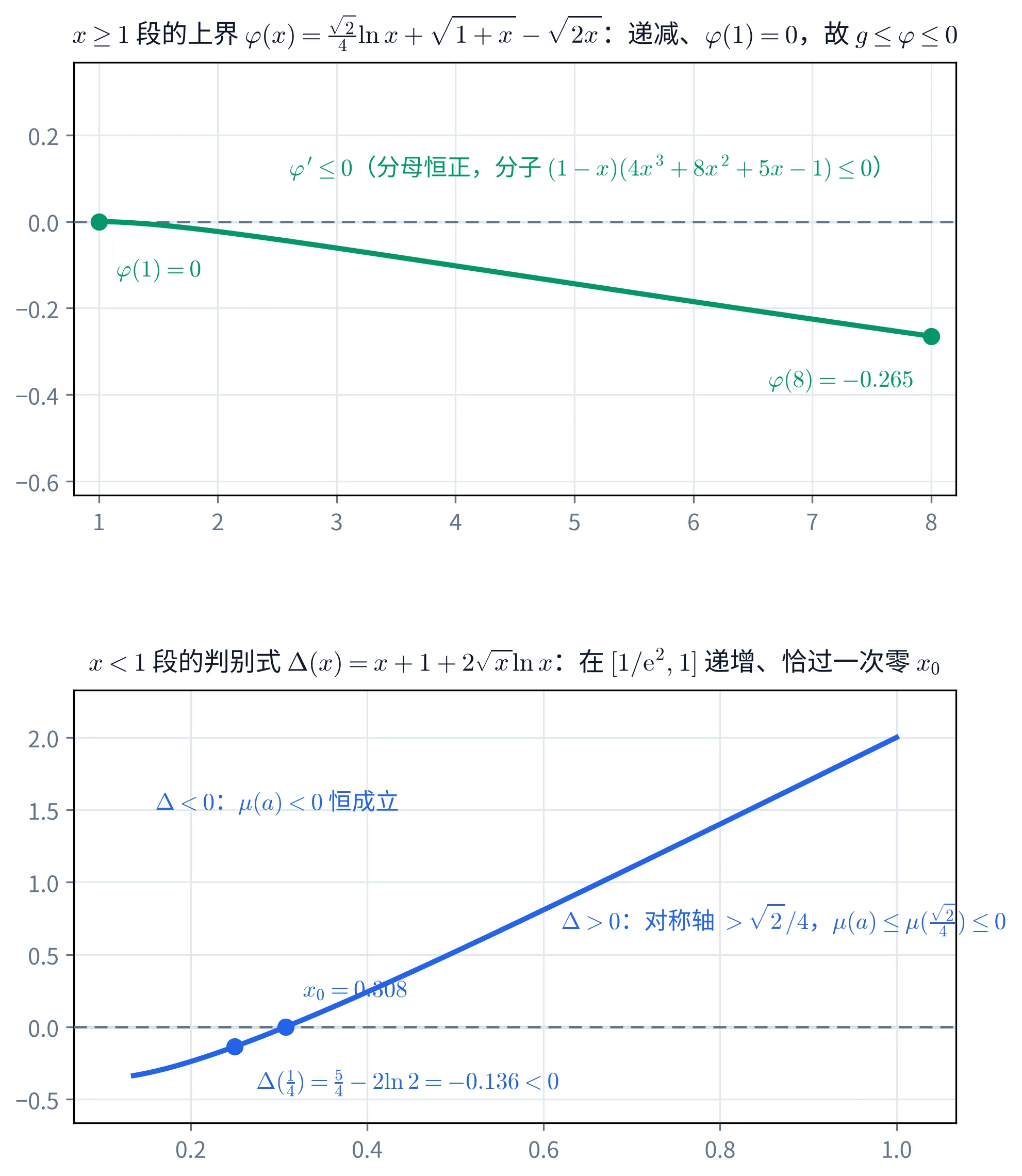
g(x)≤24ln⁡x+1+x−2x=:φ(x)g(x)\le\frac{\sqrt2}{4}\ln x+\sqrt{1+x}-\sqrt{2x}=:\varphi(x)

求导(同分母、两次有理化,把符号挤进两个因式):

φ′(x)=122 x+121+x−12x=(1−x)(4x3+8x2+5x−1)22 x1+x(1+x+2 x+2x(1+x))(22 x1+x+2x2+3x−1)\varphi'(x)=\frac{1}{2\sqrt2\,x}+\frac{1}{2\sqrt{1+x}}-\frac{1}{\sqrt{2x}} =\frac{(1-x)(4x^3+8x^2+5x-1)}{2\sqrt2\,x\sqrt{1+x}\left(\sqrt{1+x}+\sqrt2\,x+2\sqrt{x(1+x)}\right)\left(2\sqrt2\,x\sqrt{1+x}+2x^2+3x-1\right)}

x≥1x\ge1 时 1−x≤01-x\le0、4x3+8x2+5x−1>04x^3+8x^2+5x-1>0,分母恒正,所以 φ′(x)≤0\varphi'(x)\le0——φ\varphi 递减, g(x)≤φ(x)≤φ(1)=0g(x)\le\varphi(x)\le\varphi(1)=0。(这一步的代数目的就一个:把 φ′\varphi' 的符号换成 两个多项式因式的符号,其余全是恒正的「配重」;分子因式分解 (1−x)(4x3+8x2+5x−1)(1-x)(4x^3+8x^2+5x-1) 与 x=2x=2 处的数值 φ′(2)=28+123−12≈−0.0345\varphi'(2)=\tfrac{\sqrt2}{8}+\tfrac{1}{2\sqrt3}-\tfrac12\approx-0.0345 相符。)

(b) 1e2≤x<1\tfrac{1}{\mathrm{e}^2}\le x<1 一段——gg 对 aa 是个二次函数。 此时 ln⁡x<0\ln x<0, 上一段的放缩方向反转(aln⁡x≥24ln⁡xa\ln x\ge\dfrac{\sqrt2}{4}\ln x),不能再走 φ\varphi。换个主元: 两边乘 2a>02a>0,

g(x)≤0⟺ln⁡x⋅a2+x+1⋅a−12x⏟μ(a)≤0g(x)\le0 \Longleftrightarrow \underbrace{\ln x\cdot a^2+\sqrt{x+1}\cdot a-\tfrac12\sqrt{x}}_{\mu(a)}\le0

μ(a)\mu(a) 是 aa 的开口向下二次函数(首项 ln⁡x<0\ln x<0),判别式

Δ(x)=x+1+2xln⁡x=x(4ln⁡x+x+1x)\Delta(x)=x+1+2\sqrt{x}\ln x=\sqrt{x}\left(4\ln\sqrt{x}+\sqrt{x}+\frac{1}{\sqrt{x}}\right)

直接求导:Δ′(x)=1+ln⁡x+2x\Delta'(x)=1+\dfrac{\ln x+2}{\sqrt{x}}。x∈[1e2,1)x\in[\tfrac{1}{\mathrm{e}^2},1) 时 ln⁡x≥−2\ln x\ge-2,所以 Δ′(x)≥1>0\Delta'(x)\ge1>0,Δ(x)\Delta(x) 在 [1e2,1)[\tfrac{1}{\mathrm{e}^2},1) 上严格递增。 (官方解析先令 t=xt=\sqrt{x} 把 Δ\Delta 写成 x⋅h(x)\sqrt{x}\cdot h(\sqrt{x}) 再证 hh 递增——绕了弯, 而且 hh 在左端附近为负、乘积的单调性不能由两个因式直接推,本站直接用 Δ′\Delta' 更短也更稳。)

  • x∈[1e2,14]x\in\left[\tfrac{1}{\mathrm{e}^2},\tfrac14\right]: Δ(x)≤Δ(14)=54−2ln⁡2<0\Delta(x)\le\Delta\left(\tfrac14\right)=\tfrac54-2\ln2<0(即 ln⁡4>54\ln4>\tfrac54,4>e5/44>\mathrm{e}^{5/4} 成立)。 开口向下且无实根,μ(a)<0\mu(a)<0 对一切 aa 成立——这一段无条件通过。

  • x∈(14,1)x\in\left(\tfrac14,1\right):对称轴 a0=x+1−2ln⁡xa_0=\dfrac{\sqrt{x+1}}{-2\ln x} 随 xx 递增(x+1\sqrt{x+1} 增、1−ln⁡x\dfrac{1}{-\ln x} 增), 所以 a0≥a0 ⁣(14)=58ln⁡2a_0\ge a_0\!\left(\tfrac14\right)=\dfrac{\sqrt5}{8\ln2},而 58ln⁡2>24⟺ln⁡2<58\dfrac{\sqrt5}{8\ln2}>\dfrac{\sqrt2}{4}\Longleftrightarrow\ln2<\sqrt{\dfrac58}(ln⁡2≈0.693<0.791\ln2\approx0.693<0.791,成立)。 于是 0<a≤24<a00<a\le\dfrac{\sqrt2}{4}<a_0:aa 在对称轴左侧,开口向下 ⇒ μ\mu 递增 ⇒ μ(a)≤μ ⁣(24)\mu(a)\le\mu\!\left(\dfrac{\sqrt2}{4}\right)。

    最后补上原书没证的一步:μ ⁣(24)≤0\mu\!\left(\dfrac{\sqrt2}{4}\right)\le0。把它乘以 2 写成

    ψ(x):=14ln⁡x+22x+1−x\psi(x):=\frac14\ln x+\frac{\sqrt2}{2}\sqrt{x+1}-\sqrt{x} ψ′(x)=14x+24x+1−12x=x+1+2 x−2x(x+1)4xx+1\psi'(x)=\frac{1}{4x}+\frac{\sqrt2}{4\sqrt{x+1}}-\frac{1}{2\sqrt{x}} =\frac{\sqrt{x+1}+\sqrt2\,x-2\sqrt{x(x+1)}}{4x\sqrt{x+1}}

    分子非负,两行证完:由均值不等式(注意 2 x=2⋅x\sqrt2\,x=\sqrt2\cdot x 是一个整体)

    x+1+2 x≥2⋅21/4(x2(x+1))1/4\sqrt{x+1}+\sqrt2\,x\ge 2\cdot 2^{1/4}\bigl(x^2(x+1)\bigr)^{1/4}

    而 x<1x<1 时 2⋅21/4(x2(x+1))1/4≥2x(x+1)2\cdot 2^{1/4}\bigl(x^2(x+1)\bigr)^{1/4}\ge 2\sqrt{x(x+1)}(两边四次方, 等价于 2≥x+12\ge x+1)。连起来就是 x+1+2 x≥2x(x+1)\sqrt{x+1}+\sqrt2\,x\ge2\sqrt{x(x+1)},分子非负。 所以 ψ′≥0\psi'\ge0,ψ\psi 递增,ψ(x)≤ψ(1)=22⋅2−1=0\psi(x)\le\psi(1)=\dfrac{\sqrt2}{2}\cdot\sqrt2-1=0。

    于是 μ(a)≤μ ⁣(24)=12ψ(x)≤0\mu(a)\le\mu\!\left(\dfrac{\sqrt2}{4}\right)=\dfrac12\psi(x)\le0,这一段也通过。

教学图:上下两块。上块是 x≥1 段的上界曲线 φ(x)=(√2/4)ln x+√(1+x)−√(2x)(绿色实线),横轴 x 从 1 到 8:曲线从 φ(1)=0 的绿点出发单调下降、始终在灰色零线(y=0)下方,标注 φ(8)=−0.265;图内文字注明 φ′≤0 来自分母恒正、分子 (1−x)(4x³+8x²+5x−1)≤0。下块是 x<1 段的判别式 Δ(x)=x+1+2√x·ln x(蓝色实线),横轴 x 从 1/e² 到 1:曲线单调上升、恰过一次零;蓝色点标 Δ(1/4)=5/4−2ln2≈−0.136<0,蓝色点标零点 x₀=0.308;x₀ 左侧注记 Δ<0 时 μ(a)<0 恒成立,右侧注记 Δ>0 时靠对称轴与 μ(√2/4)≤0。

综上,0<a≤240<a\le\dfrac{\sqrt2}{4} 时对一切 x≥1e2x\ge\dfrac{1}{\mathrm{e}^2} 都有 g(x)≤0g(x)\le0, 与必要性合起来:aa 的取值范围是 (0,24]\left(0,\dfrac{\sqrt2}{4}\right]。

为什么这道题只有一条路

「把 aa 当主元」就是上面的 μ(a)\mu(a);「分离参数」就是把 Δ(x)\Delta(x) 的单调性单独拎出来—— 任何写法最终都要处理 x<1x<1 这一段上 gg 对 aa 非单调(ln⁡x<0\ln x<0 使放缩方向反转)的事实, 于是必须用二次函数结构。两条「看着不同」的路走到第二段都会合并成同一个 μ(a)+Δ(x)\mu(a)+\Delta(x)。

避坑清单

坑错在哪会算出什么怎么当场发现
含参导数漏掉参数非正的一支只讨论 a>0a>0,a<0a<0 不闻不问范围少写一支(这里 a<0a<0 恰好被排除,漏讨论=没排除)恒成立题先看 aa 的符号:x=1e2x=\tfrac{1}{\mathrm{e}^2} 处 a<0a<0 直接爆
必要性取的点不够只取 x=1x=1 或只取 x=1e2x=\tfrac{1}{\mathrm{e}^2}范围锁不紧(x=1e2x=\tfrac{1}{\mathrm{e}^2} 对 a>0a>0 无约束!)两个点各问一句「它给了我什么」:x=1x=1 锁上界、x=1e2x=\tfrac{1}{\mathrm{e}^2} 排 a<0a<0
放缩方向反转x<1x<1 段还按 x≥1x\ge1 段放 aln⁡x≤24ln⁡xa\ln x\le\dfrac{\sqrt2}{4}\ln xln⁡x<0\ln x<0 时这个不等式反向,g≤φg\le\varphi 不成立放缩前先看被乘的那个数(ln⁡x\ln x)的正负
均值不等式的等号没验2a+12ae≥2e2a+\dfrac{1}{2a\mathrm{e}}\ge\dfrac{2}{\sqrt{\mathrm{e}}} 直接当严格g(1e2)≤0g\left(\tfrac{1}{\mathrm{e}^2}\right)\le0 的等号情形漏查等号在 a=12ea=\tfrac{1}{2\sqrt{\mathrm{e}}} 处,此时 g(1e2)=1+1e2−2e<0g\left(\tfrac{1}{\mathrm{e}^2}\right)=\sqrt{1+\tfrac{1}{\mathrm{e}^2}}-\tfrac{2}{\sqrt{\mathrm{e}}}<0 仍是严格——写一句
φ′\varphi' 符号靠肉眼分母里根式项的正负不逐个点明符号表填错,φ\varphi 递减证错分母每一项(x≥1x\ge1 时)都是正的,列出来再下结论
二次函数 μ(a)μ(a) 的开口方向忘看首项 ln⁡x\ln x 的符号对称轴两侧的单调性用反,μ(a)≤μ(24)μ(a)\leμ(\tfrac{\sqrt2}{4}) 推不出写 μ(a)μ(a) 时顺手写「首项 ln⁡x<0\ln x<0,开口向下」
定义域端点 1e2\tfrac{1}{\mathrm{e}^2} 忘了含区间写 (1e2,+∞)\left(\tfrac{1}{\mathrm{e}^2},+\infty\right)左端点漏验题面是闭区间 [1e2,+∞)[\tfrac{1}{\mathrm{e}^2},+\infty),x=1e2x=\tfrac{1}{\mathrm{e}^2} 正是第一个特殊点

本题涉及的教材页

共 5 页